
Finally, brothers and sisters, whatever is true, whatever is noble, whatever is right, whatever is pure, whatever is lovely, whatever is admirable—if anything is excellent or praiseworthy—think about such things. (Philippians 4:8)
Happy Pride Month, Bethel.
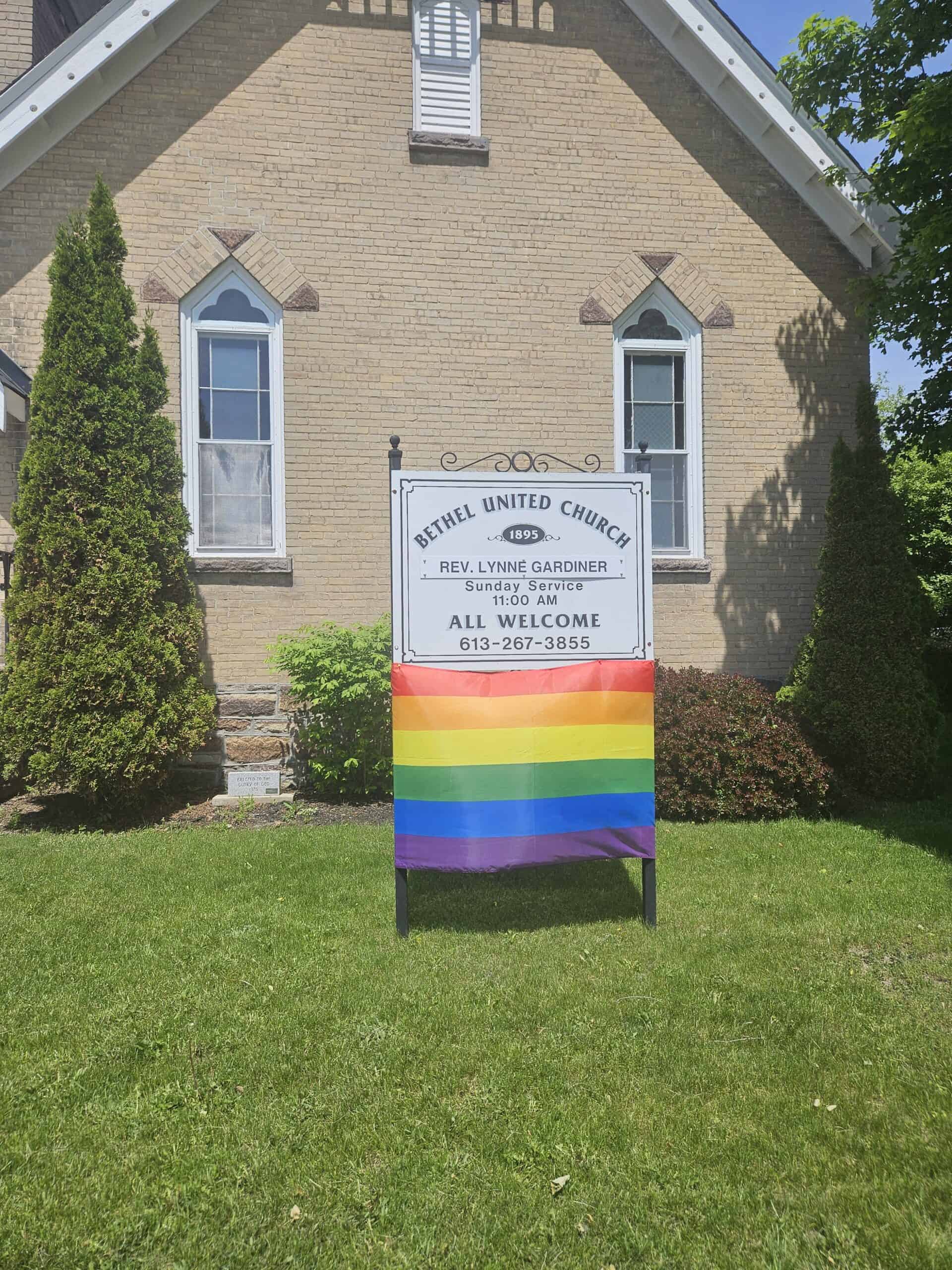
This week I posted a picture on Facebook of our Bethel sign with a rainbow flag flying beneath it. It was a simple picture, really. A church sign. A rainbow flag. A public declaration that our welcome is not vague, not private, and not conditional.
And apparently that was enough to make some people furious.
The comments came quickly. Some were threatening. Some were cruel. Some were dripping with the kind of smug, self-righteous condemnation that masquerades as holiness. You are not a real church. You are leading people astray. A woman minister cannot possibly preach the Gospel. The usual tired, ugly stuff.
Most of the comments came from fake accounts, fake names, stolen pictures. Cowardice so often travels disguised as certainty. In less than half an hour, I had blocked and deleted dozens of comments before I figured out how to restrict replies. Even now there are still angry-face emojis hanging around like little badges of outrage.
And if I am honest, it shook me for a minute.
It is never pleasant to become a target, even when the attacks are predictable. There is always that little voice that whispers: wouldn’t it be easier to just stay quiet? Wouldn’t it be easier to be the kind of church that says “all are welcome” in very small print, but never does anything concrete enough to upset anybody? Wouldn’t it be easier to avoid the rainbow flag, avoid the conversation, avoid the cost?
Yes. It would be easier.
But easier is not the same thing as faithful.
And I think we need to say that plainly.
Because too often the church has confused politeness with discipleship. We have mistaken silence for peace. We have acted as though avoiding conflict is the same thing as following Jesus. It is not.
There are moments when the Gospel demands that we speak clearly. There are moments when Christian love must become visible. There are moments when welcome has to be more than a slogan on a sign or a vague sentiment in our hearts. Pride Month is one of those moments.
At the centre of our faith is this promise: “For God so loved the world, that He gave His only begotten Son, that whosoever believeth in Him shall not perish, but have everlasting life” (John 3:16).
Whosoever.
That word has always mattered to me. Maybe because I learned it young in the King James Version, and it lodged itself deep in my soul. Whosoever. Not “some people.” Not “the approved.” Not “the easy to explain.” Not “those who make us comfortable.”
Whosoever means everybody.
And if we actually believe that, then our churches, our theology, our language, and our lives have to reflect it.
That means 2SLGBTQIA+ people are not outsiders to be cautiously admitted. They are not problems to be solved. They are not exceptions to the rule. They are not beloved by God despite who they are, as though their existence were a burden heaven is forced to tolerate.
No.
They are beloved by God, fully and freely. They are made in the image of God. They are part of the body of Christ. Their love, their faith, their courage, their questions, their gifts, and their lives are not threats to the church. They are gifts to the church.
And here is where I want to be especially clear: as Christians, we are not called merely to tolerate people. Tolerance is far too weak a word for the Gospel. Tolerance keeps people at arm’s length. Tolerance says, “You can come, but you can’t ask too much of me.” Tolerance leaves people guessing whether they are actually safe, actually valued, actually wanted.
The Gospel calls us beyond tolerance to love.
Beyond love to justice.
Beyond private kindness to public solidarity.
Full inclusion means making it unmistakably clear that queer and trans people belong in the life of the church; not as guests, not as issues, not as side conversations, but as family.
And if that makes some people angry, then maybe the question is not whether we are being too bold. Perhaps the question is whether the church has been timid for far too long.
Because, really: the church has not always been a safe place for 2SLGBTQIA+ people. In many cases, the church has been one of the places of deepest harm. Too many people have been told that who they are is sinful, shameful, disordered, or unworthy of blessing. Too many have been pushed out of sanctuaries, families, leadership, and belonging. Too many have learned to brace themselves when Christians start talking about love, because experience has taught them that “love” often arrives carrying rejection.
So when we raise a rainbow flag, when we say clearly that all are welcome, when we name 2SLGBTQIA+ people explicitly, we are not engaging in something trendy. We are participating in repentance. We are choosing truth. We are refusing to let the voices of exclusion have the final word.
And yes, that will make some people uncomfortable.
But discomfort is not persecution.
Being challenged is not oppression.
Having your assumptions questioned is not the same thing as suffering.
If my discomfort at nasty Facebook comments lasted a few hours, that is nothing—absolutely nothing—compared to the daily calculations many queer and trans people make just to move through the world safely. Nothing compared to wondering if your family will reject you. Nothing compared to being mocked, threatened, stereotyped, or denied dignity. Nothing compared to sitting in a pew and wondering whether the sermon, the prayer, or the “welcome” will eventually turn against you.
So no, I am not interested in protecting the comfort of the already comfortable if that comfort comes at the expense of someone else’s safety, dignity, or belovedness. (Ok that was a complicated sentence, but I hope you followed what I was saying)
Jesus didn’t spend his ministry protecting the comfort of the religious establishment. Jesus consistently moved toward the people others pushed aside. He crossed lines that polite religion told him not to cross. He touched those others called untouchable. He ate with those others judged unworthy. Again and again, he revealed a God whose holiness is not fragile and whose love is not stingy.
If we are serious about following Jesus, then we can’t keep drawing boundaries he spent his life tearing down.
So this Pride Month, I’ll keep posting the picture.
I’ll keep deleting the hateful comments.
I’ll keep saying that Bethel welcomes 2SLGBTQIA+ people fully, joyfully, and without apology.
I’ll keep standing under that sign and beside that rainbow flag.
Not because it is trendy.
Not because it is easy.
Not because everyone will approve.
But because it is true.
Because it is right.
Because it is lovely.
Because it is admirable.
Because it is excellent and worthy of praise.
And because the Gospel is too good, too wide, and too holy to be reduced to fear.
My friends, this is our Christian responsibility: not to whisper welcome, but to embody it. Not to offer inclusion with fine print attached, but to practice full belonging. Not to hide behind “love the sinner” slogans that leave people bruised and excluded, but to bear witness to the liberating love of Christ.
All are welcome means all.
Not some.
Not most.
Not “all, but.”
All.
That is the call.
That is the witness.
That is the Gospel.
Blessings today, and remember: you are Loved,
~Rev. Lynne
Audio File (and this week it made me cry as I recorded it!)https://audio.com/lynne-gardiner/audio/office-hours-pride
Thank you 🏳️🌈
A wonderful message. We are so lucky to have you as our “ guiding light”
Lynn Fraser.